FREQUENTLY ASKED QUESTIONS
Here are some of our frequently asked questions. If your question is not stated here, feel free to chat with us on Instagram!
What are the benefits of practising Pilates?
Pilates emphasizes active mobility, and targets deep stabilizing core and underused muscles that support proper alignment, using breath and controlled flowing movements to enhance blood flow, ease joint stiffness, and correct muscle imbalances.
It is a low-impact movement that improves mobility by lengthening tight muscles placing minimal stress on your joints, cartilage, and ligaments and boosts circulation promoting active recovery after sport or weight training by moving blood to sore tissues without heavy exertion.
How does Pilates help the spine?
Pilates promotes core stability as it targets deep stabilizers like the transversus abdominis and multifidus to support vertebrae.
The practice teaches controlled and supported spinal extension to avoid painful back-arching positions, improving movement distribution, as it frees up stiff upper-back segments so lower joints do not overcompensate.
As it promotes balanced muscle tone and spinal flexibility, this lessens daily gravitational load on the spine and results in better posture.
What is the STOTT PILATES® method?
STOTT PILATES® is a globally recognised, science-based approach to Pilates and is widely regarded as the gold standard in evidence-informed movement education. Combining precise technique, controlled breathing, and rigorous instructor training, the method promotes safe, effective, and balanced movement.
The STOTT PILATES® method focuses on core stability, deep muscle activation, and overall body conditioning. Complemented by Merrithew® equipment, accessories, and the ZEN•GA® mind-body movement modality, it helps improve mobility, restore fascial elasticity, release tension, and enhance whole-body integration.
Supported by ongoing research and innovation, the programme continually evolves with new exercises, techniques, and equipment.
What are my instructor’s qualifications and certification status?
Achieving a Full STOTT PILATES® Certification requires completing a comprehensive series of training modules covering all equipment tracks - Matwork, Reformer, Cadillac, Chair, Barrels at the Essential, Intermediate and Advanced level, logging hundreds of practice and observation hours, and passing both written and practical exams through Merrithew®. The Injuries and Special Populations modality is mandatory for full-level accreditation.
To maintain certification, STOTT PILATES® instructors are also required to complete annual continuing education, ensuring they remain current with the latest evidence-based practices.
You can check instructor certification using the Merrithew® Instructor Finder.
What is Merrithew® Pilates apparatus?
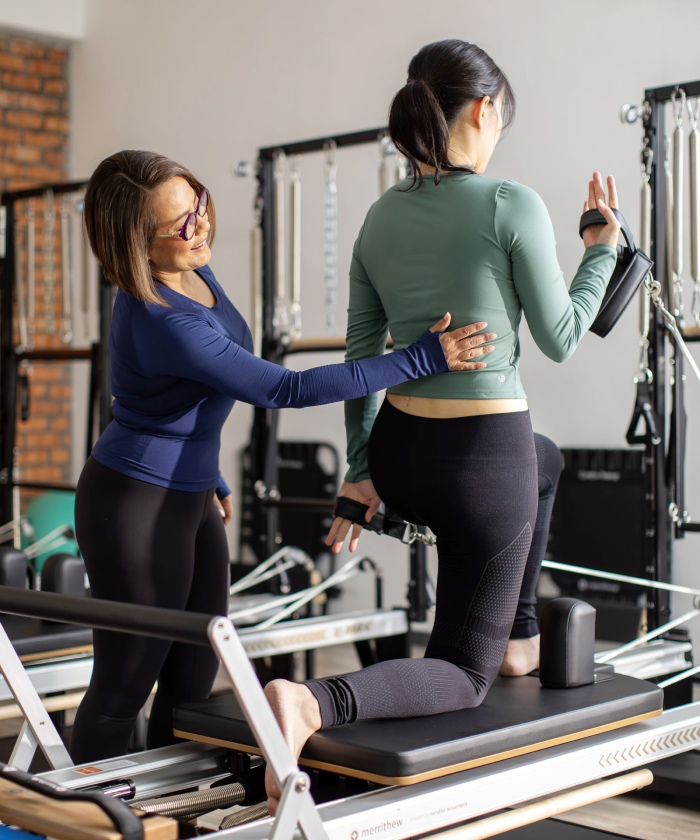
Merrithew® Pilates apparatus refers to the professional-grade line of contemporary exercise equipment designed for the STOTT PILATES® method. Core apparatuses include Reformers (like the SPX and MPX series), Stability Chairs, Cadillac Spring Walls, and various Barrels used for resistance and spinal flexibility.
Merrithew Reformers are engineered for smooth, consistent resistance and lasting durability. Designed for full teaching days and diverse bodies, innovative equipment supports instructors and enhances client outcomes.
Featuring the V2 Max™ Reformer, favorited among health and fitness professionals.
The V2 Max Reformer is certified for patient care in hospitals and health care settings across Europe.
I’m interested in learning with Meranti Pilates. Where do I start?
The best way to start is by booking a consultation call.
If you decide to take things further, you will start your journey with a first session at our Bangsar studio where we will devise a unique programme that is catered to your body. You will be guided through the principles of Pilates and learn the basics.
At first, the exercises may seem simple or require minimal effort.
As we progress, your Pilates routine will step up as your body gradually improves and your needs evolve.
Am I too old for Pilates?
Although Pilates is wildly popular among people in their physical prime, it is equally suitable at almost any age.
One of the best parts of Pilates is that it is tailored to suit each individual regardless of their age or physical condition.
Pilates is a lifestyle for many well into their eighties and nineties. With the proper tools and guidance, Pilates is one of the best ways to stay youthful.
As the founder of Pilates himself put it: ‘If, at the age of 30, you are stiff and out of shape, you are old. If, at 60, you are supple and strong, then you are young.’
Older clients may seek medical advice before starting Pilates and begin at a slower pace.
Is Pilates only for women?
Absolutely not. Pilates, as a matter of fact, was invented by a man, Joseph Pilates, for his own benefit – and was only later adapted for women.
Men tend to be a lot more inflexible and would actually benefit more from this practice.
Pilates while pregnant. Yes or no?
Pilates is completely safe and an effective workout, however, we encourage you to get clearance from your physician before starting any new exercise programmes. Pilates can help with pregnancy symptoms by optimising alignment and building strength with minimal joint stress and strain.
Can I do Pilates if I am recovering from an injury?
Pilates is a low-impact, non-aerobic exercise method, which lengthens and strengthens the muscles, and improves posture, without stressing the joints or the heart. If you are recovering from an injury, your treating physician must clear you for exercise and a rehab specialist must have restored function and mobility to the affected joint.
Is Pilates similar to Yoga?
Yoga is done through static poses with emphasis on the flow between the shifting poses. Pilates as a practice is much more dynamic and is focused on strengthening the deepest layer of abdominal muscles that corset your torso.
Both can benefit you in very different ways and can be practised simultaneously.
How long until I start seeing results?
To quote the founder of Pilates himself, ‘In ten sessions you will feel the difference; in 20 you will see the difference; and in 30 you will have a whole new body’.
Many start to notice changes in their bodies after the 10th session. They can identify that they walk taller and move in a more supple manner.
With more sessions, they begin noticing more obvious changes to their bodies from looking leaner, and more toned. They also feel more liberated in their motion as the practice continues.
Can I book a duet session with a friend?
Yes, Duo Pilates allows you to synchronise your needs with someone who has similar needs and achieve your physical goals together. Our classes use the Pilates Reformer and Tower frame for a more versatile workout.
55 MINUTES DUO sessions are available upon request.
Can I practise online with the studio?
Yes simply book a 55min online session and you’ll be able to follow through on your journey to your physical goals —whether you’re at home or at the office.
What should I wear?
Wearing something comfortable and easy to move in is encouraged. A t-shirt with leggings, tracksuit bottoms or shorts would suffice.
Shoes are not allowed on the equipment, so socks would do you best. Clean ones are even better and highly encouraged.